Following the Traces of the Maritime Silk Road, Visiting Millennia-Old Quanzhou: International Graduate Students from XMU Economics Conduct a Maritime Silk Road Cultural Study Tour in Quanzhou
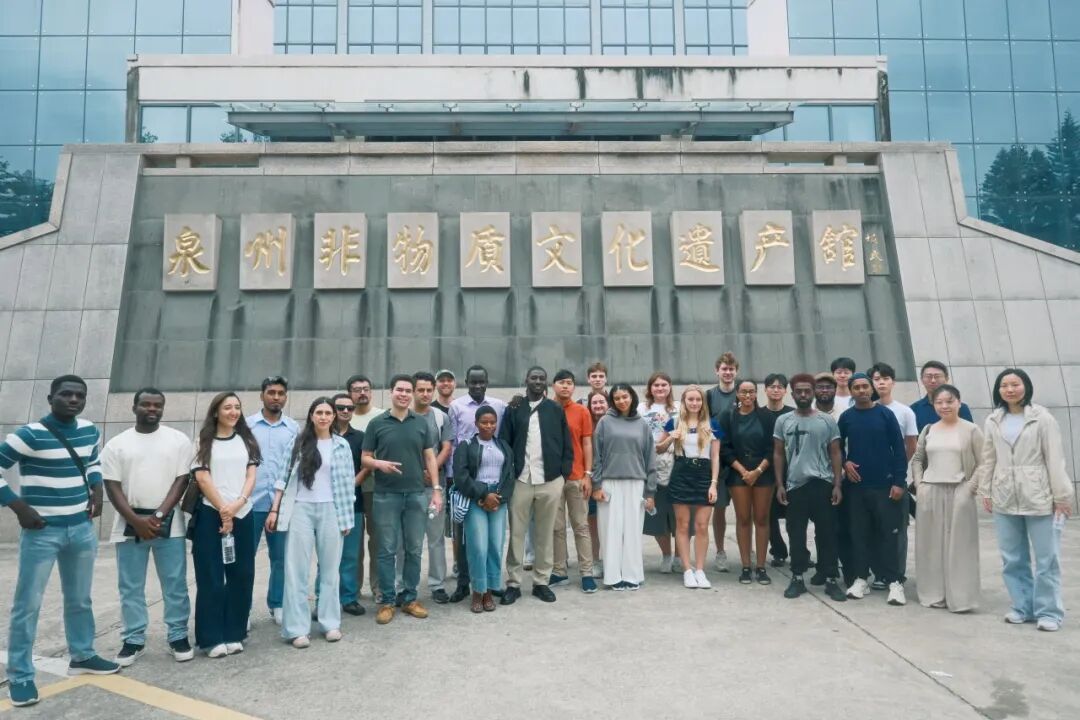
On November 6, the economics disciplines at Xiamen University organized currently enrolled international master’s and doctoral students to conduct a Maritime Silk Road cultural study tour in Quanzhou. Led by Associate Professor Zhu Weixuan, Director of the EGEI Program; Assistant Professor Wu Meng and Assistant Professor Kang Da, young faculty members in the economics disciplines; and Teaching Secretary Zeng Min, the international graduate students from different countries visited the Quanzhou Intangible Cultural Heritage Museum, Kaiyuan Temple, West Street, and Luoyang Bridge. Following the trade routes of the Song and Yuan dynasties, they explored the history and diverse cultures of this great eastern port.
01. Quanzhou Intangible Cultural Heritage Museum
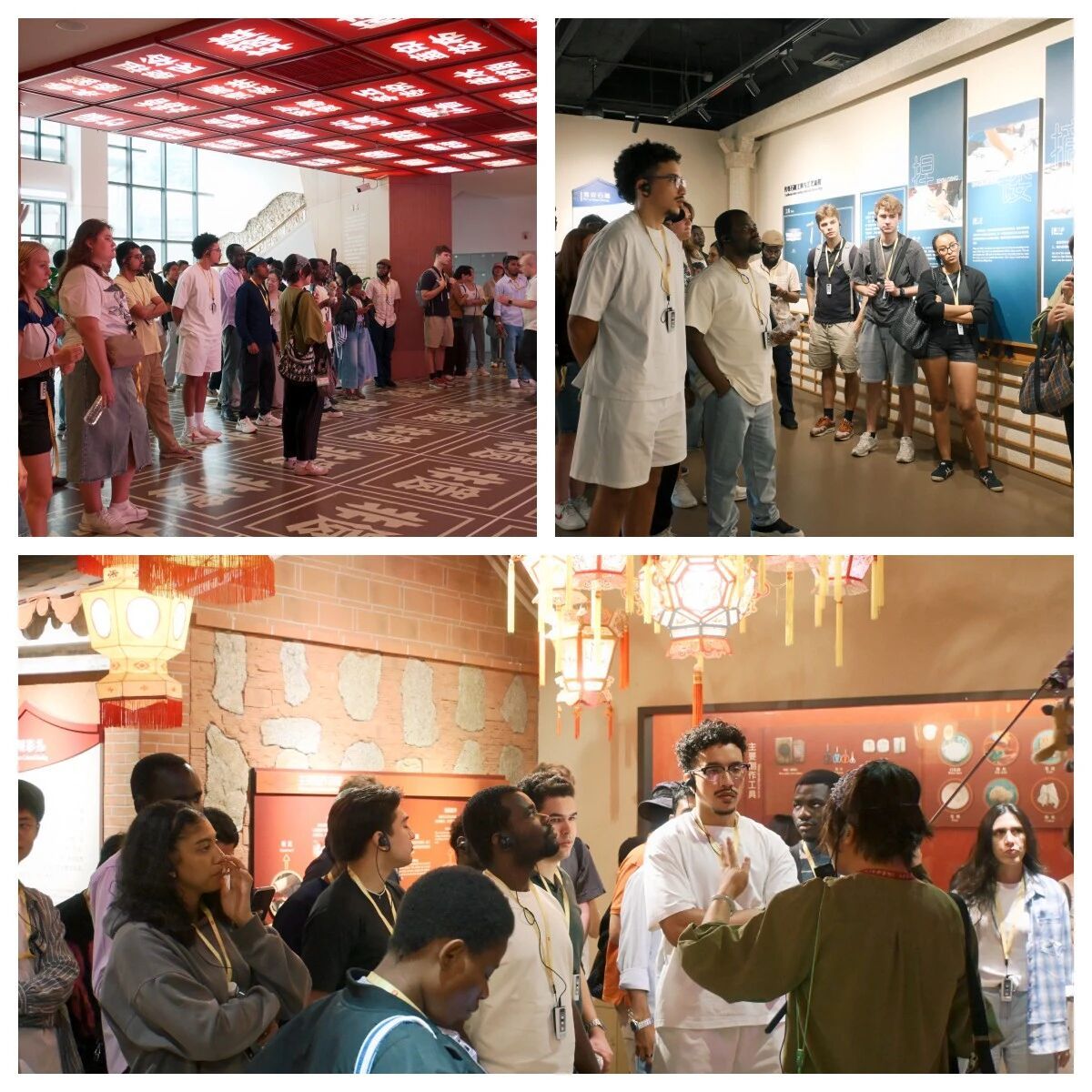
During the Song and Yuan dynasties, Quanzhou Port was crowded with merchant ships. Maritime trade promoted the exchange of civilizations and gave rise to a rich variety of folk crafts and customs. The first stop was the Quanzhou Intangible Cultural Heritage Museum. Exquisitely detailed Dehua porcelain sculptures, vivid puppet shows, and delicate Quanzhou lanterns drew everyone’s attention, and many students took out their phones to record the exhibits. The international graduate students learned in detail about tea-making techniques and gained much knowledge about tea appreciation. In front of a wall of an “oyster-shell house” built with oyster shells, the guide explained that, according to legend, ancient merchant ships used oyster shells as ballast on their return voyages, and local people later used these shells to build walls and houses. These oyster shells, which traveled across the seas, are an epitome of centuries of commercial exchanges between China and foreign countries. The exhibits and historical explanations gave the international graduate students an intuitive sense of the material flows and cultural integration driven by ancient Chinese maritime trade. Many students, drawing on their own academic backgrounds, reflected on and discussed ancient cross-regional commercial and cultural exchanges.
02. Kaiyuan Temple and West Street
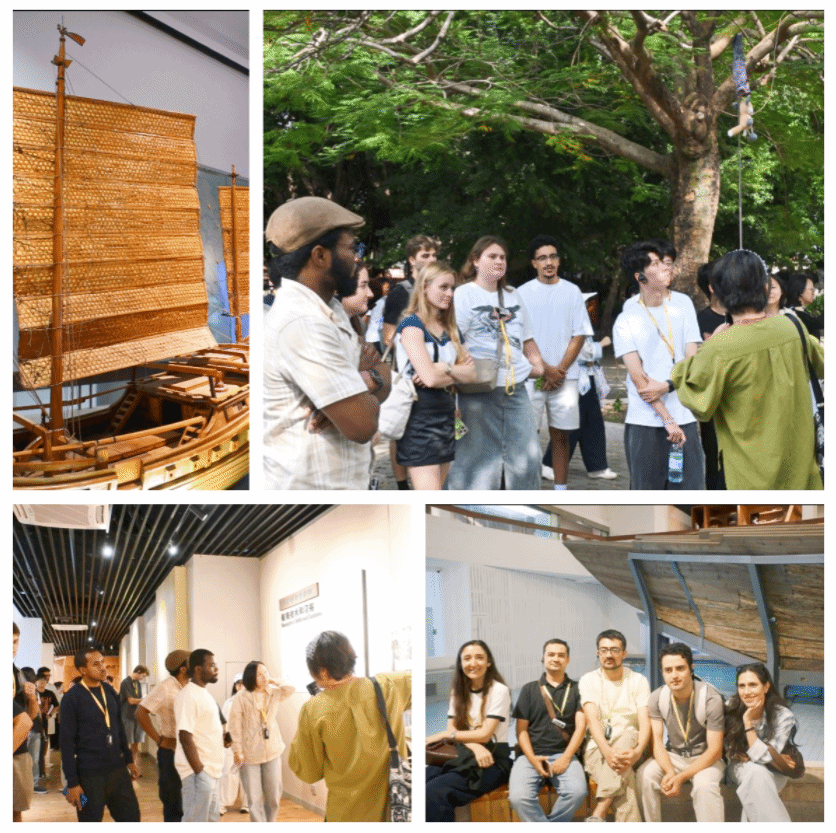
In the afternoon, the group arrived at Kaiyuan Temple, which was first built in the Tang dynasty. The ancient temple is solemn and majestic. The Zhenguo Pagoda and Renshou Pagoda stand facing each other in the east and west and have remained standing for nearly 800 years despite wind and rain. The sphinx reliefs on the Sumeru pedestal of the platform in front of the Mahavira Hall are full of exotic charm, prompting the students to examine them closely and marvel at them. The guide explained that these stone carvings originally belonged to a Hindu temple in Quanzhou during the Yuan dynasty and were moved here when the main hall was rebuilt in the Ming dynasty, bearing witness to the past coexistence and integration of diverse cultures in Quanzhou. In the Quanzhou Bay Ancient Ship Exhibition Hall inside the temple, a Song dynasty sea-going ship excavated from Quanzhou Bay is on display, with its watertight compartments clearly visible. The international graduate students from different countries listened carefully to the explanations. Through the stone carvings and the ancient ship, they gained a firsthand understanding of Quanzhou’s urban character as a major trading port in the Song and Yuan dynasties that embraced diverse civilizations.
Outside the walls of Kaiyuan Temple is West Street, which has a history of more than 1,300 years. Red-brick traditional houses, arcade-style old shops, and incense-filled temples are intertwined; the aroma of traditional local snacks fills the air, and creative cultural shops line the street. “Half the city is bustling life, half the city is immortal spirits.” Here, Minnan culture is integrated with everyday urban life. Many tourists on the street wore zanhuawei, brightly colored floral headdresses. This headdress originates from the Xunpu fishing village in Quanzhou and is a traditional adornment passed down among local women for generations. The international graduate students watched with great interest and agreed to try it themselves in the future. Walking along the lively old street, the students felt that historical heritage is not sealed away in museums but remains vividly present in the daily lives of ordinary people today.
03. Luoyang Bridge
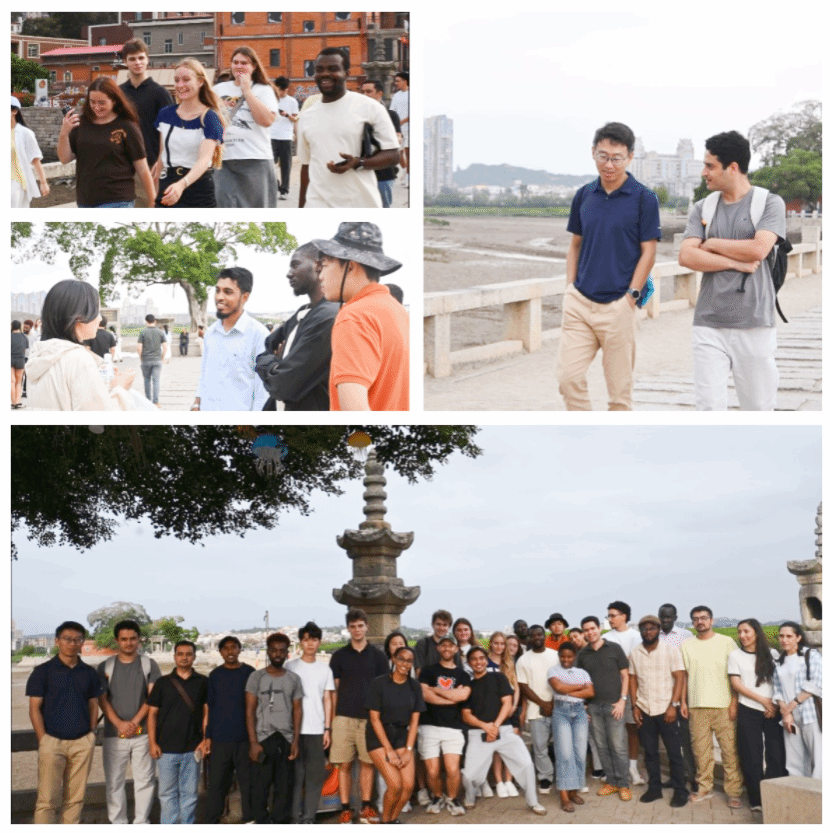
The final stop of the study tour was Luoyang Bridge, also known as Wan’an Bridge, which has long been known as the “No. 1 Bridge under Heaven.” This sea-crossing beam-style stone bridge, completed during the Northern Song dynasty, still lies quietly at the mouth of the Luoyang River. Stones were thrown into the water to build the foundation and resist the tides; oysters were cultivated to consolidate the foundation and bind the piers; and stone beams were floated into place with the tide and then installed. The students marveled at the ancient people’s wisdom in adapting construction methods to local conditions. It was low tide, and the tidal flats were exposed. Mangroves flourished along the bridge, and seabirds circled and foraged among them. Looking around, the long bridge stretched like a ribbon in the vast landscape, and the cool breeze was refreshing. Teachers and students leaned against the railings in small groups, chatting freely and taking group photos. The international graduate students remarked that this ancient sea-crossing bridge is not only an outstanding example of ancient engineering but also an important physical witness to the development of ancient maritime trade.
“In the shadows of the ancient officials’ trees lies the road to the three continents; amid the sound of rising seas are merchants from ten thousand countries.” Cizhou Port, as described in Song dynasty poetry, was once a great eastern port where merchants gathered from all directions and countless ships raced across the waters. A thousand years later, young students from countries around the world followed the footsteps of the Maritime Silk Road into Quanzhou. Among the Quanzhou Intangible Cultural Heritage Museum, ancient temples, old streets, and the long bridge, they touched the historical roots of China’s opening to the outside world. Rooted in China and facing the world, the economics disciplines at Xiamen University will continue to deepen multi-level international exchanges and cooperation, enabling more overseas young people to understand China’s development and China’s stories, and to grow into young ambassadors who connect China with the world and promote mutual learning and exchange between China and other countries.
Student Reflections
Kaleem Ahmed (Master’s student from Pakistan):It was so good to visit such historical places. It would be great if more such activities are arranged for international students.
Savanna Kausler (Master’s exchange student from Germany):Very interesting, very thoroughly thought out. The cultural insights were captivating, the guide was maintaining our interest at all times. Thank you very much for organizing and giving us the opportunity to discover China!
Umar Ado (Master’s student from Nigeria):I was impressed by how well Chinese cultural history is preserved in the museum.